To respond to the content of this course, I have chosen a video. I am so delighted that there was an opportunity to respond to the content of this course in an artistic way. I have been so impressed with the style of teaching and learning in this course. I think it is a better example of what I want to see available to young students as well. It is challenging to step outside the comfortable world of ‘you tell, I regurgitate,’ but I definitely feel that I have thought more than I usually would ‘get away with.’ It is also riveting content.
It is not possible to consider the four modules of this course in isolation. I did consider that a choose your own adventure would have been the best way to respond to the content, but too technically hard for me to do by computer.
I have used my child, she is 12, in a lot of this video as she is living the experience of being “educated,” and she is the antagonist in our education story. I also believe in modeling the joy of learning, so I have included my child in my learning, especially as she has always been interested in education – as an intellectual idea. She is also always here to talk to!!
Act one: The story of Mr David’s was written by her. Out of interest, I asked her to write a story of the dominant paradigm of life as an early child’s reader. It is telling that her life has no resemblance to this, yet she knows this general idea – the interpellations are out there, she is exposed to them despite the lack of modelling in her actual life (she has a solo parent, we live with her granddad, we live within a low income, have no interest in status, etc). We are trying to be funny yet cause discomfort. I do not talk to children like I do in this video (Teacher Tom), but I have been an early primary teacher and know many of the rituals. I was interested in Freire’s ideas of the oppressor/oppressed relationship. If children (I do mean 5 year olds) are the oppressed (universally), and when I think of the control adults have over their lives (both physical and mental) under the guise of school, I can only come to that conclusion. So then, as they are as articulate as 5 year olds are… they will not say that they are ‘committed to transforming the oppression’, so I should change and drastically to really listen.. ie before conscientization, for example, self-determination: I should let children take the lead in when they want to read. Like the Smith (2005) model, where you can enter the conscientização cycle at any point.
Act two: This came with some pretty intense baggage. What does it mean to be a New Zelander is something I have wrestled with for years. Where am I at home? There is no doubt in my mind that colonisation negatively affects both colonised and coloniser, as does the role of oppressor and oppressed – Freire talks about our joint struggle to become more human. Changing this dynamic requires action.. I know that I have been suffering pākehā paralysis. As we listened to the RNZ history show, visited the Te tohu exhibit, and the call for submissions on the Fast Track bill came, they merged into an action. I see this as the kind of thing that will happen with the new history curriculum.
I was so excited by He puapua and a possible future I could feel fully human in. In our NZ history “unit,” we started thinking about the ebb and flow of control, which we tried to animate in a generalised way. Housing, medical (plasters), (matches), crops (popcorn), meat land (farm animals), meat (sea), native forests (Manuka leaves), native animals (a kiwi), dominant knowledge system (books), and lastly people – green = Māori, blue = European, red and yellow = other immigrants.
My friend Raiha (5) has just started at Otari in the immersion strand and told me that “māra is the word for garden in Māori.” I think of this as evidence she wants me to come with her into her future. Like Whitney says “I believe the children are our future, Teach them well and let them lead the way”…Twee but true.. I mean teach as an activity of gifting in the manner Biesta (2012).
Act three: This is the section I have the most discomfort with. Bertrand Russell wrote, “… for a victory dependant upon authority is unreal and illusionary. ” Over the course of these readings, I have decided it is time to start my own school based on the model of the Sudbury schools in the US, playcentre philosophy, and the six principles advocated by Smith (2005).
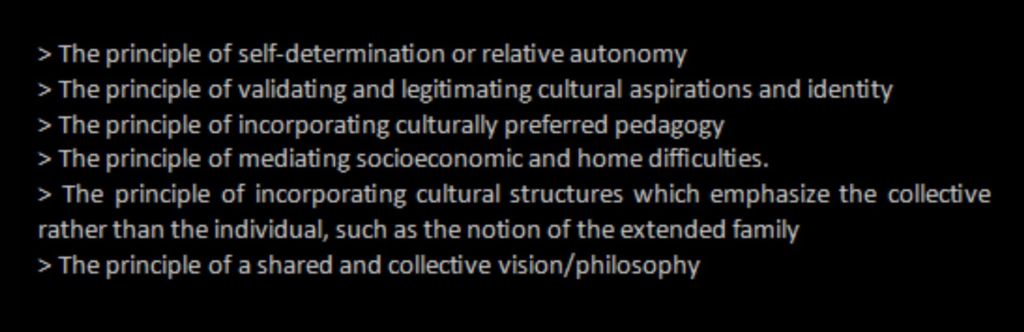
The idea is to try and have more community involvement – providing after-school care, parents at all times welcome, access for all (including adults, we need something less linear (Gilbert 2005)) to learn, a climate focus, (bottling of excess fruit) etc.. I am currently in discussions with other parents, the homeschool community, a colleague who started a Montessori school in Porirua, nature schools, and an after-school education provider. The goal is to make the education personal – respond to individual students (because through belonging comes participation, and through participation comes learning (Rogoff, 2003)). There is no universal child (Frankel S) and no unitary Māori (Carter J). More time outside (how can we access matauranga Māori otherwise). Expand on the idea of trissesment (NZCER). Promote subjectification (Biesta 2020) To use the knowledge in the community (U3A, etc) and make connections between people – and eventually to lead to a portfolio style of qualification with real-world research projects (Gilbert 2005).
Act four: Here I disagree, or don’t understand. A knowledge system can not be a static thing, as that would imply that the world is unchanging and unquestioned. Neither is there a lack of choice in your knowledge system. A knowledge system reflects the age, class, and who you want to fit in with… I am successful within the system I wish to belong to. When confronted with the dominant paradigm, I practice passive resistance (thanks Te Whiti o Rongomai and Tohu Kakahi). Today’s students are constructing a different knowledge system (eg, we even talk about periods in a different way now). My response should be to listen as they will be providing my health care, pension, etc…. I should provide examples of community so they can see connectedness of any actions of society.
I posed a question along the lines of, “Where does your knowledge come from, how do we use knowledge?” to my child. We enjoy philosopical and metacognitive conversations. She is adamant that her brain contains multiple ways of knowing and separates the things she has been told from the things she personally has evidence for, and also acknowledges that there is a part of her that is creative and makes her own knowledge (like the concept of working theories (Davis K, McKenzie R 2016)). At different times, one draws on a different set of knowledge. She includes a biological dimension to include the lenses we see the world through (autism, dyslexia, shyness) that are inate.
Biesta, G. (2012). Giving Teaching Back to Education: Responding to the Disappearance of the Teacher. Phenomenology & Practice, 6(2), 35-49.
Biesta, G. (2020), Risking Ourselves in Education: Qualification, Socialization, and Subjectification Revisited. Education Theory,
Carter, J. (1998) Growing up Māori. None of Us is What Our Tūpuna Were: When ‘Growing up Pākehā’ is ‘Growing up Māori’
Copson A, Roberts A (2020). the little book of humanism, Russell B, p116
Down, P. Werry, S. Bell, G. Sketch, R. (2016) Ngā reo e toru: “Trissesment” from invitation to expectation. NZCER
Davis K, McKenzie R. (2016). Rainbows sameness and other working theories. NZCER
Durie, M. () Indigenous Knowledge Within a Global Knowledge System
Frankel, S. (2018) Giving children a voice. Equipping kids.
Freire, P. (1970) Pedagogy of the oppessed.
Gilbert, J. Catching the Knowledge Wave? The Knowledge Society and the future of education.
Charters, C (chairperson DWG 2019) He Puapua
Jackson, M. (Nov 2022) What it means to be at home in this land. E-TANGATA
Land of the long white cloud, Episode 4: Pākehā Paralysis RNZ
Rogoff, B. (2003)
Smith, G. H. (2005). Beyond political literacy: From conscientization to transformative praxis. Counterpoints, 275, 29-42.
Teacher Tom. Tuesday, May 07, 2004. Speaking with children so they can think.

 Anne Bieleski Portfolio
Leave a comment